If you’re reading this, something has probably been building for a while: they knew where you were, again. They referenced a conversation they couldn’t have heard. They picked a fight about a message you never showed them. You’ve explained it away each time, and the explanations are wearing thin. This guide is for exactly this moment, and it begins with the thing technical guides skip: what’s happening is not primarily a malware problem. It’s a controlling-behavior problem expressed through a phone — and the response has to fit the real problem, in the right order.
That order is: steady yourself, get support, preserve evidence, secure your communications, then — when the timing is yours — remove the surveillance and close the doors. Here is each step.
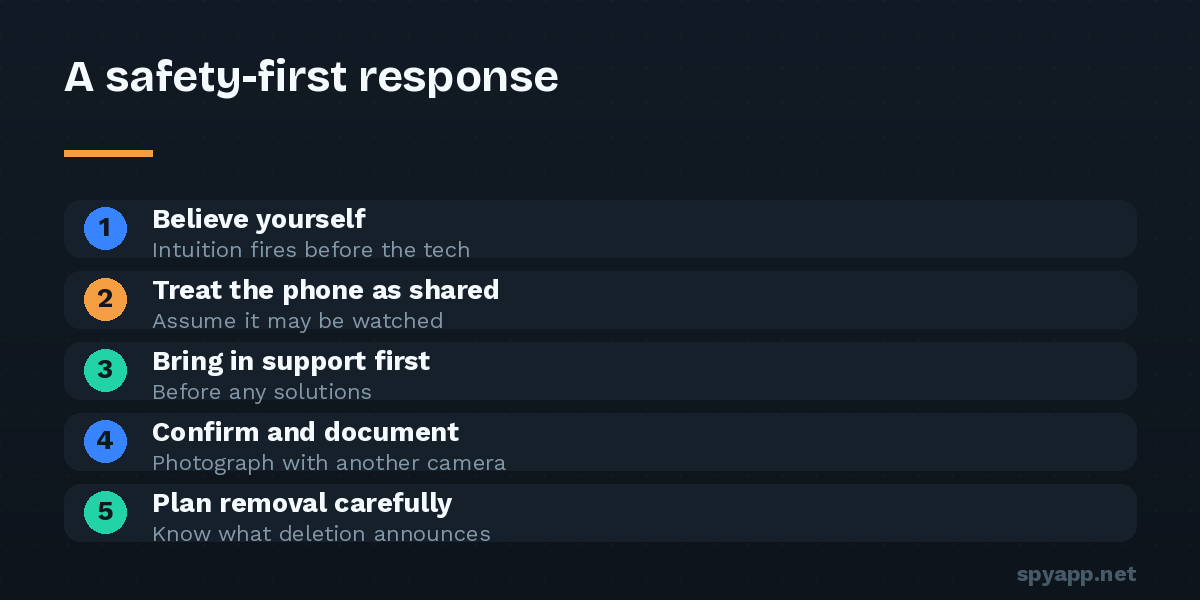
First: believe yourself
The pattern of someone knowing too much is evidence. People in this situation typically doubt themselves for months, because every single incident has a plausible innocent explanation — and monitoring partners actively supply those explanations (“a friend mentioned it,” “you told me, you forgot,” “lucky guess”). You don’t need certainty to take the steps below; they’re safe and sensible even if you turn out to be wrong. And for what it’s worth: people who get as far as searching this topic are more often right than not.
One important reframe before anything technical: if your partner is covertly monitoring your phone, they have done something wrong — and in most places, something illegal. Secretly installing surveillance software on another adult’s device typically violates wiretapping, computer-misuse or stalking laws. You are not being dramatic, oversensitive, or paranoid. You are responding to a violation.
Second: assume the phone is shared space, starting now
Until it’s been checked and cleaned, treat the monitored phone the way you’d treat a conversation with the person standing in the room. Don’t research escape plans, support hotlines, or this topic on it. Don’t message confidants about your suspicions on it. Many tracking tools see the screen itself — searches, chats, everything (our explainer on what spyware can see covers why even encrypted apps aren’t protected on a compromised device).
For anything sensitive, use a separate channel: a trusted friend’s phone, a work computer, a library. Keep using the monitored phone normally for everything else — sudden silence is itself a signal to someone watching a dashboard.
Third: bring in support before you bring in solutions
This is the step that distinguishes a safe response from a fast one. Domestic-violence support organizations deal with phone surveillance constantly — you will not be their strangest call, and you don’t need bruises or a crisis to qualify for their help. What they offer that no website can: safety planning specific to your situation, judgment about timing, knowledge of local legal options, and a person to think alongside.
The Coalition Against Stalkerware (stopstalkerware.org) lists organizations by country. Contact them from a safe device. If you’re unsure whether your situation is “serious enough” — that uncertainty is itself worth a call.
Fourth: confirm and document — without tipping the dashboard
You can verify quietly. Checking settings looks like using a phone; nothing below alerts anyone:
- Settings → Accessibility → Downloaded apps — anything unfamiliar here can read your entire screen.
- Settings → Security → Device admin apps — beyond Find My Device and work tools, this should be empty.
- The full app list for generic system-sounding names you didn’t install, plus background data and battery use by unfamiliar apps (the full audit walkthrough).
- The no-app routes: Google Maps location sharing, devices signed into your Google account, linked devices in WhatsApp/Telegram. A surprising share of partner tracking is a forgotten share or a logged-in session, not malware — though finding one doesn’t rule out the other.
Whatever you find, photograph it with a different camera: the app’s info screen, its Accessibility and device-admin entries, the location shares, dated. If you ever want legal options, evidence captured before removal is what makes them real. If you can export the suspicious app’s APK, a report from our free scanner identifies the product and its capabilities — useful for understanding what was visible, and for describing the software precisely to police or a lawyer later.
Don’t remove anything yet.
Fifth: understand what removal will announce
Delete the app and their dashboard goes dark; many products also send tamper alerts. Either way, the message received is: discovered. In relationships with controlling dynamics, that moment can escalate behavior — which is why its timing belongs inside a plan, not at the end of a settings menu. With your support contact, decide: remove now, remove when you’re somewhere safe, remove alongside other steps (a conversation, a departure, a report), or leave it temporarily while routing your real life through a safe device. All four are legitimate; what matters is that the choice is deliberate and yours. Our safe removal guide covers this decision and the technical steps in full.
Sixth: the cleanup, when you’re ready
The short version (the removal guide has the detail): airplane mode → revoke device admin → revoke Accessibility → uninstall (safe mode if it resists) — or a factory reset for certainty, set up as new. Then close every door the same day: a new PIN they have never seen, only your biometrics enrolled, Google password changed from a clean device with two-factor authentication on, unknown sessions signed out everywhere, location shares ended, recovery email and phone verified as yours, carrier PIN set.
What this was never about
Tracking software is sold with the language of love and worry — “I just need to know you’re safe.” But monitoring a partner in secret isn’t an excess of care; it’s a substitute for trust imposed without consent, and it tends to travel with other forms of control. However the relationship proceeds, you’re entitled to a phone that answers only to you — and to support while you get there. The people at those hotlines spend every day helping with exactly this. Let them.